The Steel Industry is undergoing significant changes in 2026. Nippon Steel has acquired U.S. Steel, a move that has garnered considerable attention from politicians. This acquisition has led to a National Security Agreement, allowing the U.S. government to oversee the company. The merger aims to enhance U.S. Steel's ability to compete on a global scale while also focusing on modernizing outdated factories. By incorporating new technology and pursuing decarbonization, the industry can produce better steel products. These advancements align with sustainability goals. Currently, trade rules, technological improvements, and environmental regulations play a crucial role in shaping how companies strategize and compete within the steel industry.
Key Takeaways
Nippon Steel bought U.S. Steel. This shows that steel companies are joining together more often. They want to be stronger and update how they make steel.
When steel companies merge, they can spend less money. They can make their supply chains work better. They can also reach their sustainability goals. This helps them survive in the world market.
Steel companies must use new technology and save energy. This helps them stay strong against other companies. It also lowers their costs.
Sustainability is now very important. Companies use more recycled materials. They also use cleaner ways to make steel. This helps them follow environmental rules.
Trade rules and laws change the steel industry a lot. These rules affect prices and how the market works. Steel companies must change to keep up.
Steel Industry Consolidation Trends
Recent Mergers and Acquisitions
Many steel companies have joined together lately. They want to work better, reach more customers, and face worldwide rivals. The table below shows why companies merge and gives examples:
Factor Driving Consolidation | Description | Example |
Cost Reduction & Efficiency Gains | Mergers help companies save money and work faster. | ArcelorMittal and Nippon Steel's acquisitions. |
Supply Chain Optimization | Companies buy others to control their supply chain. | Cleveland-Cliffs’ acquisition of AK Steel. |
Global Competition & Market Expansion | Mergers make companies stronger for global markets. | Nucor's acquisitions in construction markets. |
Environmental & Sustainability Pressures | Merging helps companies use cleaner technology. | Collaborations on green steel initiatives. |
Increased Demand for Specialty Metals | Mergers help companies create new metals for tech. | Alcoa and Rio Tinto’s Elysis partnership. |
Big deals have changed the Steel Industry since 2020. The next table lists some of the largest deals and what they mean:
Company A | Company B | Deal Status | Enterprise Value | Strategic Implications |
Nippon Steel | U.S. Steel | Closed June 18, 2025 | ~$14.9B | Sets a new standard for deals between countries; needs U.S. national-security agreement. |
Cleveland-Cliffs | Stelco | Completed late 2024 | ~$2.5B | Saves about $120M each year; shows how merging helps companies grow. |
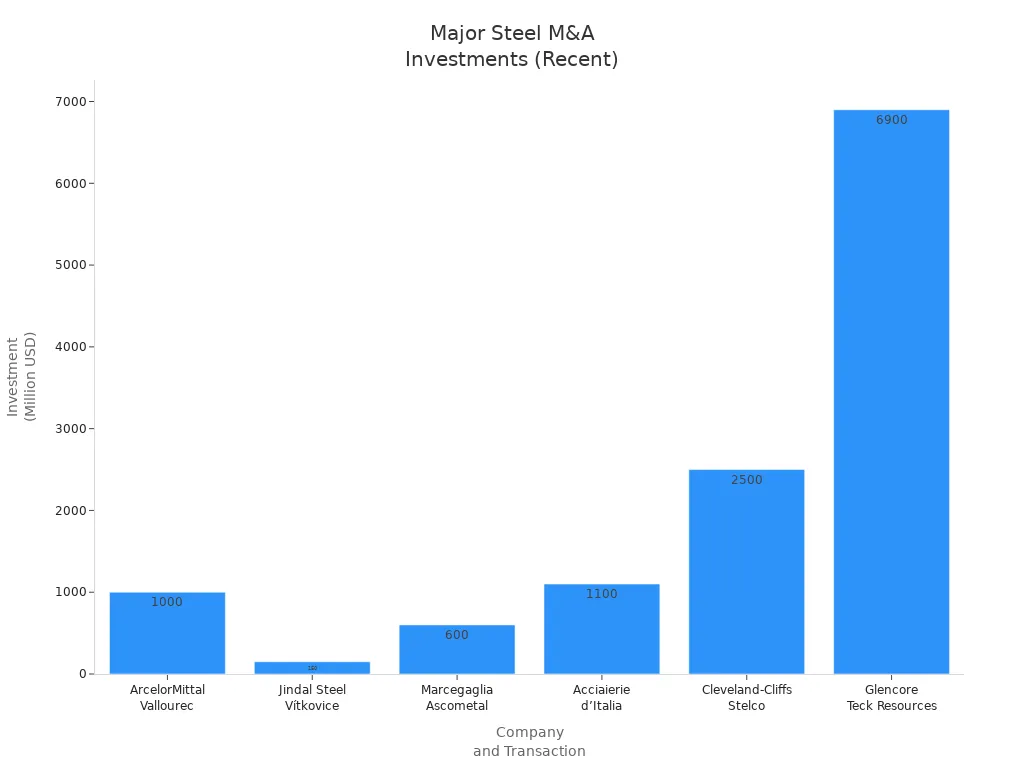
Looking at deals around the world shows how big and different these mergers are:
Company/Transaction | Details | Investment/Stake |
ArcelorMittal | Bought 28.4% of Vallourec in France | Over $1 billion |
ArcelorMittal | Bought 60% of Brazil’s Tuper | N/A |
voestalpine | Sold Buderus Edelstahl to Mutares | N/A |
Thyssenkrupp | Gave some control to EP Corporate Group | N/A |
Jindal Steel | Bought Vítkovice Steel | €150 million for green changes |
Marcegaglia | Bought Ascometal plant in Fos-sur-Mer | €600 million for upgrades |
Liberty Steel | Assets in trouble, Whyalla Steelworks for sale | N/A |
Salzgitter AG | Stopped talks to stay independent | N/A |
Grupo Celsa | Sold UK and Scandinavian plants to Sev.en GI fund | N/A |
Acciaierie d’Italia | Under state control, may sell to Azerbaijani group | €1.1 billion and up to €4 billion in investments |
Cleveland-Cliffs | Will buy Stelco | $2.5 billion |
Glencore | Will buy 77% of Teck Resources’ coal business | $6.9 billion |
Key Players and Market Changes
Some companies are now very important in the Steel Industry because of mergers. These companies can change prices and control the market:
Cleveland-Cliffs Inc. grew bigger by buying other companies and wants to lead the U.S. market.
Nucor Corporation is still a big part of industry mergers.
Nippon Steel made a big deal by buying U.S. Steel.
Mergers made companies larger. Now, these companies control more of the market and can set prices. For example, China Baowu Steel Group got bigger by buying another steel company. This shows that there are fewer, but stronger, companies now.
Note: Bigger companies can spend more on new technology and cleaner ways to make steel. This helps them stay ahead.
Impact of Global Deals
Deals between companies from different countries have changed the Steel Industry. When big companies buy assets in other places, they get new markets and resources. For example, a global steel company bought Tata Steel’s European business. This helped them work better and compete harder.
These deals also help companies learn from each other and use new technology. The Steel Industry gets stronger and can handle future problems better.
Strategic Drivers of M&A
Technology and Energy Efficiency
New technology is very important for steel company mergers. Companies want better tools to keep up with others. They also want to meet what customers will need soon. Many steel makers spend money on new machines and computers. These changes help them make stronger steel and save money. Saving energy is another big reason for companies to join together. If a company spends $5 million on energy-saving tools, it can use less power. By 2027, this could cut energy bills by 10%. A factory making 100,000 tons of steel beams could save $550,000 each year. This extra money makes joining with other companies look good. Companies also use smart computer programs to move things faster and use less energy. This helps them pollute less and stay strong in a tough market.
Sustainability and Steel Recycling
Steel companies now care more about the planet and recycling. They want to make less pollution and use more old steel. Big companies lead these changes because they have more money and power.
"Steel makers in the U.S. recycle a lot of steel scrap," said Kevin Dempsey, president and CEO of the American Iron and Steel Institute. "Big steel companies use a lot of scrap, so they help recycling efforts."
"Does being bigger help a company do better? Companies in this spot think about being green for a long time," said Michael E. Hoffman, CEO of the National Waste & Recycling Association. "When companies join, they can use more recycled steel faster."
"If you use a lot of scrap, should you control your supply? It is almost a must," Hites writes in Recycling Today. "That is why Steel Dynamics bought OmniSource in 2007, Nucor bought DJJ in 2008, Steel Dynamics bought a Mexican scrap company in 2020 for its new Texas mill, and Cleveland-Cliffs bought Ferrous Processing and Trading Co. in 2021."
Being green shapes many choices in the Steel Industry. Companies want to make less carbon and use cleaner machines. Some important trends are:
Green goals push steel companies to use new machines and cut carbon.
The European Union's Green Deal gives rewards for cleaner projects and changes how companies work there.
China’s five-year plan wants fewer but stronger companies and cleaner factories.
Companies spend money on green steel, like using hydrogen or electric arc furnaces.
More companies use wind or solar power to make their supply chains better.
Trade Policies and Regulatory Impact
Trade rules and laws also change why companies join together. New U.S. trade rules put extra costs on steel from other countries. This makes U.S. steel factories worth more. Companies with U.S. plants get more attention from buyers, even from other countries. Higher costs for imports change how much companies are worth. Foreign buyers want to skip these costs, so they look for U.S. steel makers.
New rules in big steel countries also change deals. Some key points are:
Harder rules make big deals tough and smaller deals safer.
Governments watch deals with important minerals very closely.
New green rules make steel companies buy cleaner machines.
Companies must follow these rules to keep up with others.
Meeting world green goals brings hard work but also new chances.
The Steel Industry is changing a lot because of new tech, green ideas, and trade rules. Companies join together to keep growing and stay strong in this new world.
Case Studies
Nippon Steel and U.S. Steel Deal
Nippon Steel buying U.S. Steel is a big event. This deal shows how companies join to keep up with changes. Nippon Steel had many reasons for this move. They wanted to make more steel around the world. They also wanted better technology. The company wanted to meet more steel needs in the U.S. They hoped to become a top steelmaker with great skills. They also wanted to keep up with changes in the steel business.
The deal changed the market in many ways. Nippon Steel can now sell steel in North America. This helps them not depend on just one place. The merger brings new research and smart workers. This makes their technology better. The new company can get materials, make steel, and send it out faster. This helps people who build with metal. The bigger company might keep prices steady or lower costs. But the government will check to make sure prices are fair.
This deal shows that bigger and smarter steelmakers can do well around the world and spend money on new machines.
Service Center Mergers
Mergers between service centers have changed how steel gets to people. Some big deals made it easier to move steel from makers to buyers.
Company | Acquisition | Date Closed | Value (EV) | Impact Description |
Nippon Steel | U.S. Steel | June 18, 2025 | $14.9B | Grows in North America and updates flat-rolled steel making. |
Cleveland-Cliffs | Stelco | Late 2024 | $2.5B | Focuses on flat-rolled steel and better shipping. |
Ryerson | Olympic Steel | October 28, 2025 | N/A | Makes a bigger service center and helps send steel across the country. |
Russel Metals | 7 Kloeckner U.S. centers | September 28, 2025 | N/A | Grows in more places and serves more areas. |
These deals help companies find more buyers and deliver steel faster.
Lessons from Recent Transactions
Recent deals teach some important lessons. Companies that buy new technology and fix how they get supplies do better. Mergers help companies follow new rules for the environment and what customers want. Bigger companies can handle price changes and market shifts more easily. Local mergers help companies bring steel to customers faster and give better service.
Steel Industry leaders use mergers to make their companies stronger and ready for new problems.
Competitive Shifts in the Steel Industry
Pricing Power and Supply Chain Changes
Big steel companies now control prices and supply chains more. When companies join together, they get stronger power to talk with suppliers and customers. This means prices stay steady and buyers have fewer choices. The table below shows how joining companies changes price control:
Aspect | Details |
Negotiation Leverage | Big steel companies can get better deals with suppliers and customers. |
Price Stability | Joining companies helps keep prices steady as big players control supply and demand. |
Reduced Supplier Choices | Fewer suppliers means less choice for buying steel, which affects price and supply. |
Recent deals also change how companies handle their supply chains. For example, Nippon Steel bought U.S. Steel and made new investments. This connected U.S. factories to a worldwide network. ArcelorMittal spent over $3 billion in North America and sold plants that were not making money. They wanted to focus on stronger markets. These changes help companies send steel faster and work better.
Regional and Global Consolidation
Joining companies changes how they compete in different places. In Asia, Chinese groups like Baosteel move into the Middle East. They make more steel and send more to other countries. Europe spends money on new and cleaner steel factories. This helps them compete with other countries. North America sees new deals between the U.S. and Canada to keep the market steady. The table below shows these changes:
Region | Key Developments | Impact on Competition |
Asia | Chinese groups grow in the Middle East | More steel made and sent out, changing world trade. |
Europe | Money spent on new and clean factories | Focus on being green, changing how prices are set worldwide. |
North America | U.S.-Canada steel and aluminum deal | Tries to fix trade problems and keep the market steady. |
EU | Plans to double tariffs on steel from other places | Protects the EU market and stops outside companies from competing. |
The EU wants to double tariffs on steel from other countries.
Tariff-free steel import quotas will drop by almost half.
The U.S. and Canada work together to lower money problems in steel.
Effects on Small Producers
Small steel companies face new problems because there are fewer big companies. They have fewer suppliers to pick from and must depend more on big companies. This can make prices go up and cause supply chain problems. The table below shows the main problems:
Challenge | Description |
Limited Choices | Fewer suppliers make it harder to find good prices or special steel. |
Increased Dependency | Depending on fewer suppliers makes supply chain problems worse. |
Operational Disruptions | Joining companies can mess up buying and running factories. |
Higher Prices | Less competition can mean steel costs more. |
Less Innovation | Fewer companies can slow down new ideas and improvements. |
Note: Small companies must change fast to survive. They may need to make special steel or work with others to stay strong in the changing Steel Industry.
Outlook for 2026
Expected Drivers and Challenges
The Steel Industry will face many big changes in 2026. Companies think the world will grow at a steady pace. Some places will buy more steel, while others slow down. Tariffs will still make prices and supply chains hard to predict. U.S. trade rules will keep affecting how much steel costs. Being green now helps companies make more money. Green steel is seen as special and costs more. Some regions like Africa, South America, and Asia will need more steel. These places are becoming important for the industry. Wars and politics can change energy prices and how easy it is to get materials.
Driver | Description |
Moderate Global Growth | Demand stabilizes, with emerging markets offsetting slowdowns elsewhere. |
Tariff-Driven Risk | U.S. trade policy creates unpredictability in pricing and supply chains. |
Sustainability as Profit | Green steel becomes a premium product. |
Regional Rebalancing | New demand centers emerge in Africa, South America, and Asia. |
Geopolitical Pressures | Conflicts and politics impact energy and materials. |
The industry has some tough problems to solve. Trade barriers and too much steel being made are big issues. Money problems also make things harder for companies. The EU and UK will end some trade rules soon. This could make markets less steady. More countries want to protect their own steel makers. Too much steel could be made by 2027, which is a lot. China’s economy puts pressure on prices and makes it harder to get loans.
Strategic Priorities for Stakeholders
People in the industry should focus on a few main things:
Stop making too much steel and fight unfair trade, as the European Commission says.
Cut down on CO2 by using the Net Zero Steel Sector Transition Strategy.
Make steel in ways that help the planet and treat workers fairly, like with ResponsibleSteel.
Tip: Companies that use cleaner machines and treat workers well can do better than others.
Future Opportunities
There are new chances for the next three years:
More people want green metals and steel as clean energy grows.
Companies can charge more for steel that is better for the planet.
U.S. Steel will spend $14 billion to grow, with most spent by 2028.
Working with Nippon Steel could bring $3 billion in value and save over 100,000 U.S. jobs.
Steel companies that make green products and try new ideas will find ways to grow and help their towns.
The Steel Industry is changing fast in 2026. Companies need to keep up with new technology and rules. Markets are also different now. Leaders can get stronger by doing a few things.
Spend money on flexible factories and digital tools.
Make good connections with buyers and use many raw materials.
Look for mergers that help with new and green skills.
Strategy | Description |
Proactive Regulatory Monitoring | Make teams to watch and follow new rules. |
Sustainable Practice Investment | Use tech that fits green standards. |
Stakeholder Engagement | Work with others to help make and follow rules. |
FAQ
What drives steel industry mergers in 2026?
Steel companies want to get bigger and save money. They also want to use new technology. Green rules are important, too. Merging helps them reach these goals faster.
How do trade policies affect steel companies?
Trade policies set tariffs and rules for steel imports. These rules change steel prices. Companies must follow the rules to stay strong.
Why does sustainability matter in steel production?
Sustainability helps companies make less pollution and save energy. People and governments want cleaner steel. Companies that go green can do better than others.
What challenges do small steel producers face?
Small producers have fewer places to buy materials. They must compete with bigger companies. Many have higher costs and less power in the market.
How can companies prepare for future changes?
Companies should buy new technology and start green projects. They need to watch trade rules and work with partners. Being flexible helps them win.