You can see a big change in steel consumption around the world as places like India and Southeast Asia become more important. Steel is very important for building things and helping the economy grow. In the last ten years, you can see some trends:
More people in India and Southeast Asia want steel products.
China uses less steel each year.
India’s part of the market may be three times bigger by 2050.
Steel consumption in these places will help decide how industry and growth look in the future.
Key Takeaways
Steel use is growing fast in India and ASEAN. This is because more people are moving to cities and new buildings are being made. India's need for steel will go up by 9% each year. This shows India is very important in the world steel market. ASEAN countries are making more steel now. Vietnam and Indonesia are the top countries in this group. Africa's steel market is also getting bigger. But there are problems like unstable governments and trouble moving supplies. These problems need to be fixed. Using green steel technology is very important. It helps the industry protect the environment and grow in a good way.
Global Steel Consumption Trends
Emerging Markets Leading Demand
There is a big change happening in the steel industry. Countries like India, Saudi Arabia, Egypt, and Vietnam are now very important. They need a lot of steel for new buildings, roads, and factories. This means they use more steel for their projects.
India’s steel use is expected to go up by 9% from 2025 to 2026.
Vietnam is growing fastest in steel use in Southeast Asia.
Egypt and Saudi Arabia also use more steel each year.
India will use 75 million tonnes more steel than in 2020.
Steel use in these places grows faster than in older markets. Governments spend money on new roads and buildings. This helps the steel industry get bigger. The ASEAN region, including Vietnam, is a big part of this change.
Shifting Patterns in Steel Industry
The steel industry is changing in many places. New steel plants are being built in Asia, the Middle East, and Africa. These new plants make more steel to meet the higher need. At the same time, the steel industry in the U.S. and Europe is getting smaller.
Here is a table that shows how the steel industry is changing in different places:
Region | Production Trend | Consumption Trend |
Asia | Increasing | Increasing |
Middle East | Increasing | Increasing |
U.S. | Declining | Declining |
Europe | Declining | Declining |
India | Increasing | Increasing |
Iran | Increasing | Increasing |
Asia and the Middle East are now leading the steel industry. These places grow because people invest money and want more steel. The steel industry in the U.S. and Europe is shrinking as they use less steel. This change gives new chances for growth in other places.
India Steel Consumption
Market Growth and Statistics
Steel use in India is growing fast. In October 2025, India used 13.6 million tons of steel. This is 4.7% more than last year. From April to October 2025, people used 96.44 million tons of steel. This is a 12.53% increase from the year before. These numbers show that the steel industry is getting bigger quickly.
In October 2025, steel use was 13.6 million tons, up 4.7%.
From April to October 2025, steel use was 96.44 million tons, up 12.53%.
Experts think this growth will keep going. They say steel demand will go up by about 9% each year in 2025 and 2026. By 2026, India might use 75 million metric tons more steel than in 2020.
Key Drivers: Infrastructure, Urbanization, Policy
Building new roads, bridges, and cities helps the steel industry grow. The government made the National Steel Policy 2017 to help the industry. This policy gives rules for making good steel for many things.
The National Steel Policy 2017 shows a plan for the future.
The government spends money on roads, energy, and city projects.
Programs like 'Make in India' and big projects like Bharatmala and Sagarmala need a lot of steel.
These actions help the steel industry and the economy. When you see new buildings and better roads, it is because of these plans.
Production Capacity and Export Diversification
Steel factories in India are getting bigger. Companies like JSW Steel, Tata Steel, and AM/NS India are making more steel.
Company | Capacity in 2015/2021 | Projected Capacity by FY26 |
JSW Steel | 18 million tonnes | 33 million tonnes |
Tata Steel | 20 million tonnes | 27 million tonnes |
AM/NS India | 9 million tonnes | 16 million tonnes |
India now sends more steel to the Middle East and Asia. These places need steel for new buildings and roads. This helps India find new buyers and lowers risk.
Challenges: Trade, Environment, Supply Chain
The steel industry in India has some problems. These include trade, the environment, and supply chain issues.
India gets about 60% of its coking coal from Australia.
There is not enough coking coal for all the steel factories.
Problems in Australia could make it hard to get coal later.
There are other problems too:
Steel factories are growing faster than iron ore and scrap supply.
Iron ore production is not enough, so quality drops and prices go up.
India buys a lot of scrap, which makes prices change a lot.
These problems can slow down the steel industry if they are not fixed.
Steel Consumption Outlook for India
The future looks good for steel in India. The market should grow by about 3.94% each year from 2025 to 2035. This is because of more building projects, more people moving to cities, and new factories.
In 2023, the government set aside about USD 18 billion for building things. This will need a lot of steel.
The PLI scheme, starting in 2024, will help make more steel and new ideas.
The steel industry will keep growing as technology gets better and more people use steel.
India will become more important in the world steel market. The country’s focus on new ideas and caring for the environment will shape how steel is used in the future.
ASEAN Steel Industry
Consumption and Market Ranking
The ASEAN region is now very important in the steel industry. The ASEAN-6 countries are fourth in the world for using steel. Indonesia uses the most steel in this group.
Country | Steel Consumption (2021) | Global Ranking (2023) | Export Share (2023) |
Indonesia | 15.46 million tons | 4th | 5.61% |
This table shows Indonesia’s strong place in steel. All together, the ASEAN-6 use more than 75 million tonnes of steel.
Drivers: Industrialization, Construction, Integration
Many things help the steel industry grow in ASEAN countries.
The ASEAN-6 keep making more steel to help build new things.
More people and bigger cities mean more steel is needed.
Working together in the region makes trading steel easier.
These things help the steel industry give steel to new cities, factories, and roads.
Production, Imports, and Low-Cost Advantage
The steel industry in ASEAN has good points and hard parts.
Vietnam made 22 million tons of crude steel and 30 million tons of finished steel in 2024. This is 7% more than last year.
Thailand pays more to make steel than Vietnam and Indonesia. This makes it harder for Thailand to grow, so it makes special steel products.
Indonesia has old factories and it costs a lot to make them new. This makes it hard for Indonesia to keep up with Vietnam.
In Vietnam, building things uses over 93% of the steel. New roads and buildings make people want more steel in the region.
Some countries can make steel for less money, but others need to update their factories to stay strong.
Challenges: Regulation, Fragmentation, Logistics
The steel industry in ASEAN has some problems.
Each country has different rules, so it is hard to work together.
There are many small companies in the industry.
Moving steel and materials can be slow because of transport problems.
These problems can make it hard for the industry to grow and meet all the needs.
Steel Consumption Outlook in ASEAN
Steel use in ASEAN should keep growing. More people living in cities and new plans will need more steel. Building things and making cars and electronics will help the industry. But, prices for materials and tough competition could be a problem. The steel industry must change to keep getting bigger.
Africa Steel Consumption Outlook
Growth Potential and Market Dynamics
Africa is becoming important in the steel industry. The market is getting bigger as more countries build things. South Africa’s Steel Products Market will grow from USD 1.18 trillion in 2025 to USD 1.62 trillion by 2031. This means it will grow at 5.4% each year. The MEA Steel Market is now worth USD 13 billion. Steel use in Africa will keep rising, with a growth rate of 0.8% from 2024 to 2035. By 2035, the market will reach 26 million tons and $17.7 billion. Egypt makes and uses the most finished steel, with almost half the market. Algeria is also growing fast in using and selling steel.
More buildings are being built all over Africa.
Governments spend money on public and private projects.
New buildings use more local steel.
The green steel market is growing because of clean energy projects.
Drivers: Infrastructure, Urbanization, Resources
Steel is needed for roads, bridges, and factories. It is strong and can handle Africa’s weather. Steel can be recycled, so countries do not need to import as much. Money spent on steel helps build new ports and factory areas. These projects give people jobs and connect cities and villages. More people are moving to cities, so more homes and factories are needed. Steel helps every part of building up industry.
Production Capacity and Investment Trends
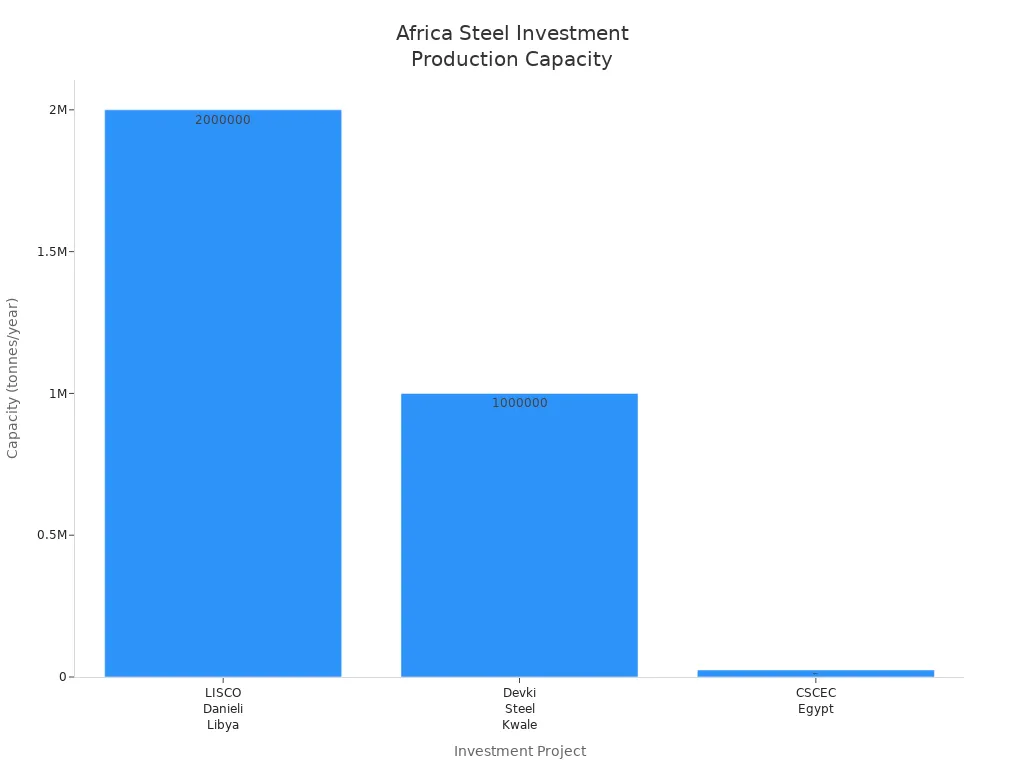
New investments are making the steel industry stronger. Here is a table with some new projects:
Company/Project | Production Capacity | Date |
LISCO (Libya) & Danieli | 2 million tonnes/year | April 2024 |
Devki Steel (Kenya) | 1 million tonnes/year | Nov 2022 |
CSCEC (Egypt) | 25,000 tonnes/year | April 2024 |
These projects show that the steel industry is getting bigger and better.
Challenges: Political, Supply Chain, Financing
There are some problems for steel in Africa. Changes in government can slow down building. Sometimes it is hard to get the materials needed. Many companies have trouble getting money. These problems can make it take longer to build new factories and use more steel.
Long-Term Steel Industry Outlook in Africa
The future for steel in Africa looks good. The market should grow by 3.10% each year from 2025 to 2034. By 2034, Africa will make about 53.59 million tonnes of steel. Building things will keep making people want more steel. More steel made in Africa and new types of steel will help the industry. There will be more jobs and better roads and buildings as the industry grows. Africa’s steel future looks strong and full of promise.
Comparative Analysis & Global Implications
Regional Growth and Market Size
India, ASEAN, and Africa are making big changes in the steel industry. Each place grows at its own speed and size. India is growing fast and has a huge market. ASEAN countries, like Vietnam and Indonesia, want more steel and change quickly. Africa is smaller but keeps growing as more countries build new things.
Region | Growth Rate (2025-2035) | Market Size (2035, million tons) | Key Driver |
India | 3.94% | 200+ | Urbanization |
ASEAN-6 | 4.5% | 100+ | Construction |
Africa | 3.10% | 53.59 | Infrastructure |
India and ASEAN have bigger markets and grow faster than Africa. Africa’s market is not as big, but it can still get much larger. All three places need more steel for buildings, roads, and factories. This new need is changing how the steel industry will look in the future.
Shared Challenges in Steel Industry
All these regions face many of the same problems. These problems slow down growth and make it hard to reach goals.
It is hard to get raw materials because of supply chain issues.
Political changes can stop or slow down big building projects.
Many companies do not have enough money to build new factories.
Different rules in each country make trading steel harder.
The steel industry must work on decarbonization to meet net-zero targets.
The steel industry needs to fix these problems to keep growing. Better transport, clear rules, and more money are needed. Using green steel and low-carbon technology helps protect the environment. The International Energy Agency says emissions must drop by 25% in six years. This means emissions need to go down by more than 4% every year. The steel industry is not meeting this goal yet, so changes must happen soon.
Impact on Global Steel Consumption and Strategies
Steel companies around the world are changing their plans. They want to meet new demand from India, ASEAN, and Africa. Companies are building new factories and making old ones better. They spend money on green steel and clean steel to follow new rules. There is more focus on decarbonization pathways and decarbonization technologies.
Aspect | Details |
Demand Trends | The global steel demand will go up by 1.3% by 2026, with India and ASEAN growing the most. |
Capacity Dynamics | Steel capacity will rise by 6.7% from 2025 to 2027, mostly in China and India, to meet higher demand. |
Sustainability Efforts | Big companies are spending money on green steel and making factories cleaner to meet new standards. |
The steel industry now uses more energy-saving technology and recycled materials. Companies try carbon capture and storage to cut emissions. They also look for new energy sources. These steps help move toward decarbonization and green steel.
Note: Green steel and decarbonization pathways are needed to reach net-zero targets. The steel industry must change quickly to help meet the Paris Agreement’s 1.5°C goal.
Green steel is now very important in the industry. Companies must use green steel to stay strong in the market. They also need to follow new rules and use decarbonization pathways. Doing this helps the world reach net-zero targets and build a better future.
India, ASEAN, and Africa are changing the steel industry. Each region has a special role in this change.
Region | Key Findings |
India | Steel demand is rising because of new buildings and factories. Urbanization and manufacturing also help this growth. |
ASEAN | Fast industry growth comes from foreign money and more people joining the middle class. |
Africa | Steel demand could be high, but slow growth happens because there are not enough roads and buildings. |
The steel industry faces new problems like credit risk and needing green technology.
Investors should pay attention to market changes and new rules.
The steel industry will help other areas like electronics and green energy grow.
You need to think about how these changes might affect your business and plans for the future.
FAQ
What makes steel important for emerging markets?
You need steel to build roads, bridges, and factories. Steel helps your country grow. It supports jobs and new businesses. When you see new buildings, you see the power of steel.
Why do India, ASEAN, and Africa use more steel now?
You see more people moving to cities. Governments spend money on new projects. Factories and homes need steel. These changes increase steel demand every year.
What challenges do these regions face in steel production?
You face problems like not enough raw materials, changing rules, and high costs. Companies also need to use cleaner technology to protect the environment.
How does green steel help the environment?
Green steel uses less energy and creates fewer emissions. You help fight climate change when you choose green steel. Companies use new technology to make steel cleaner.