You see big changes in steel trade as CBAM starts. The EU exports iron and steel worth €77.8 billion and imports €73.1 billion. You notice a trade surplus and rising values. CBAM makes you pay duties for imported
steel products like
galvanized steel and
galvalume steel. This raises costs and gives EU steel producers a boost. You watch countries shift their trade flows and adopt new carbon pricing strategies.
Key Takeaways
CBAM adds new fees to steel from other countries. This makes steel from outside the EU more expensive. EU steel becomes more competitive because of this change.
Exporters must tell the EU about carbon emissions in their steel. They need to collect correct data to follow the rules.
The carbon fee for steel sent to the EU is about EUR 37.50 per tonne. This cost will go up by 2026.
Steel makers with high emissions face big problems. They have more paperwork and may get fined if they do not follow the rules.
Countries with lower emissions will do better in the EU market. Countries with high emissions may not be able to sell as much steel.
Steel makers need to use low-carbon technology to stay competitive. This helps them meet CBAM rules.
Working together can help companies share good ideas. It also helps them lower carbon emissions.
It is important to know about new rules and changes. Companies must change their supply chains to succeed in steel trade.
CBAM Changes for Steel Trade
CBAM Compliance for Exporters
Emissions Reporting
When you export steel to the EU, you have new rules. The carbon border adjustment mechanism makes you report carbon emissions in your products. You need to collect data about how much carbon your steel production creates. This helps the EU see the environmental impact of imported steel. You must update contracts and supply chain papers to give this information to EU customers.
Tip: Start tracking your emissions early. This makes reporting easier and helps you avoid mistakes.
Here is a table showing the main compliance requirements you must follow:
Compliance Requirement | Description |
Reporting Embedded Carbon Emissions | Importers must report data on the carbon emissions in their products during the transitional phase. |
Financial Obligations | After the transitional phase, importers must declare import volumes and carbon emissions or face penalties. |
Product Scope | Compliance applies to certain iron and steel goods, aluminum, iron ore, hydrogen, fertilizers, electricity, and mineral products. |
Supply Chain Documentation | Contracts must be updated to make sure compliance and provide needed carbon data to EU customers. |
Certification Process
You also need to finish a certification process. The EU wants to check that your emissions data is correct. You must show proof and get certificates to show your steel follows the rules. If you do not do this, you may get penalties or delays at the border. Many steel exporters now spend more time and money on paperwork. For smaller importers, compliance costs can be €5,440 to €6,900 per year if they handle less than 50 tonnes each year. About 75% of all CBAM liabilities affect iron and steel importers, so you are not alone in facing these changes.
Pricing and Cost Impact
Carbon Fees for Imports
You will have new costs when you export steel to the EU. The CBAM makes you pay a carbon fee for every tonne of steel you send. The fee is about EUR 37.50 per tonne. This is like what EU producers pay under the Emissions Trading System, where prices are EUR 20 to EUR 80 per tonne. You must buy certificates for your emissions, and these costs will probably go up over time. By 2026, high-intensity steel imports could have extra costs of €40–€60 per tonne. For upstream products like steel slab, these costs may be more than 20% of the import value. The EU plans to fully use the CBAM by 2034, so you need to get ready for higher costs in the future.
The iron and steel sector is most affected by these new fees.
You must declare your import volumes and emissions or face penalties.
EUA prices may rise from €70–75 per tonne in 2025 to around €130 per tonne by 2030.
Price Differences
The CBAM changes how you compete in the steel trade. The mechanism tries to make things fair between EU and non-EU producers. You now pay a carbon price on imported steel, just like EU producers do. This lowers the price gap between EU-made steel and imported steel. But the CBAM can also raise costs for EU-produced steel, which may make it less competitive sometimes. Some companies may think about moving their manufacturing outside the EU to avoid higher costs. This could cause more carbon emissions in other parts of the supply chain.
The CBAM covers a large part of emissions under the EU's Emissions Trading System.
The mechanism deals with the difference in carbon pricing between EU and non-EU producers.
You must watch for changes in price differences as the CBAM takes full effect.
You can see that the global steel trade is changing. The carbon border adjustment mechanism brings new compliance steps and costs. You must adjust to these changes to stay competitive in the steel trade.
Competitiveness Impact
EU vs. Non-EU Steel Producers
Level Playing Field
You will see a big change in how the steel market works. The cbam brings both environmental and trade rules together. It puts a carbon price on imported steel. This means you and other non-EU producers must pay for the carbon in your products. European steel producers already pay for their emissions. Now, you face similar costs. This stops unfair competition and helps reduce carbon emissions around the world. The cbam makes sure that everyone follows the same rules. You cannot sell cheaper steel just because you do not pay for carbon. This creates a fair market for all.
The cbam also protects european steel producers. They do not have to worry about losing business to companies that do not pay for their pollution. You must now think about your own carbon costs if you want to stay in the global steel trade.
High-Emission Producer Challenges
If you make steel with high emissions, you will face many challenges. You must track and report your carbon data. This takes time and money. You may need to change your supply chain or upgrade your equipment. Here are some problems you might face:
Administrative burden: You must do more paperwork and reporting.
Trade disputes: Some countries may argue about these new rules.
Supply chain disruption: You may need to find new suppliers or change your process.
Uncertainty: Carbon prices can change, making it hard to plan.
Compliance costs: You may need to spend a lot on new systems and upgrades.
For some companies, these costs can reach hundreds of thousands or even millions of euros. If you run a small or medium business, these costs can be very hard to manage.
Global Steel Trade Flows
Trade Diversion
The cbam will change how steel moves around the world. EU importers will look for suppliers who can give clear carbon data. If you cannot meet the cbam rules, you may lose your place in the EU market. You might have to sell your steel somewhere else. Some countries, like the UK, plan to start their own cbam. This could make trade even more complex. You must watch for new rules in other markets.
You may see supply chains shift to countries with lower emissions.
Some exporters may stop selling to the EU and look for new buyers.
The cbam can lead to more trade between countries with similar carbon rules.
Export Destinations
You will notice changes in where steel goes. Some countries will find it harder to sell to the EU because of high cbam charges. Others may become more attractive as suppliers. Here is a table showing how cbam affects different countries:
Country | Default Emissions Value (tCO₂e/t) | CBAM Charges (€ per tonne) | Competitiveness Impact |
China | 3.167 | 144 | Decreased |
India | High (200-600) | 234-703 | Decreased |
Indonesia | High (200-600) | 234-703 | Decreased |
Brazil | Milder increase | Manageable | More attractive |
You can see that countries with high emissions will lose their edge in the EU market. Countries with cleaner steel will have a better chance. The cbam will reshape global steel trade by changing who sells and who buys steel.
Supply Chain Adjustments
Sourcing Strategies
Production Relocation
Steel producers are changing how they get materials because of cbam. Many companies now look for places with less carbon emissions and more renewable energy. The MENA region is important. Its steel industry uses Electric Arc Furnace technology. This makes less CO2 than old methods. MENA has gas reserves and lots of solar energy. Its ports connect to Europe and Asia easily. Most MENA mills make long steel. The eu likes flat steel more. CBAM limits steel trade from China to Europe. Higher costs make Chinese steel less competitive in the eu. China may invest in green steel to keep up with global trade.
Low-Carbon Inputs
You need to watch the demand for low-carbon steel inputs. Many eu buyers do not want to import because cbam charges are unclear. Rules are uncertain, so trading for 2026 deliveries is slow. Economic conditions also limit demand for green steel. Producers choose slow changes instead of big investments in low-carbon tech.
"Uncertainty about benchmarks and default values has slowed trading for 2026 imports. Some importers will not buy cargoes without knowing the exact cbam charge."
Here is a table showing how steel producers change their methods to lower carbon impact:
Production Method | Carbon Emissions Impact | Key Features |
Electric Arc Furnace (EAF) | Lower emissions | Uses less energy, has lots of recycled content |
Basic Oxygen Furnace (BOF) | Higher emissions | Needs better energy efficiency |
Procurement Optimization | Carbon costs considered | New ways to connect parts and use secondary steel to lower carbon |
Green Steel Investment
Technology Adoption
Big steel producers are investing in green steel tech. Companies like Tata Steel work with start-ups to make sustainable steel. ThyssenKrupp started a venture capital group to cut emissions. The eu’s cbam pushes producers to use low-carbon tech. The U.S. Department of Energy gives money and tax credits for green steel. Electric Arc Furnace with renewable energy is used a lot. Hydrogen-Based Direct Reduction is being tested by many companies. Carbon Capture, Utilization, and Storage helps lower emissions from old methods.
Electric Arc Furnace with renewable energy is flexible and good for recycling.
Hydrogen-Based Direct Reduction aims to cut emissions deeply.
Carbon Capture, Utilization, and Storage lowers emissions from older ways.
Industry Collaboration
Industry collaborations are growing to support green steel. Platforms like UNIDO’s Industrial Deep Decarbonisation Initiative and SteelZero bring companies and governments together. Regional collaborations between climate-friendly countries help green steel trade. Partnerships between steelmakers and users balance costs and keep supply chains sustainable.
Aspect | Description |
Multi-Stakeholder Platforms | Groups work together on decarbonization goals. |
Regional Collaborations | Deals between climate-friendly countries help green steel trade. |
Strategic Partnerships | Long-term deals balance costs and keep supply chains sustainable. |
CBAM is making companies invest and work together for green steel. The effect on steel trade and global trade is clear. Decarbonization is now a top goal for producers and buyers.
Strategic Responses to CBAM
Steel Exporter Adaptation
Carbon Reduction Initiatives
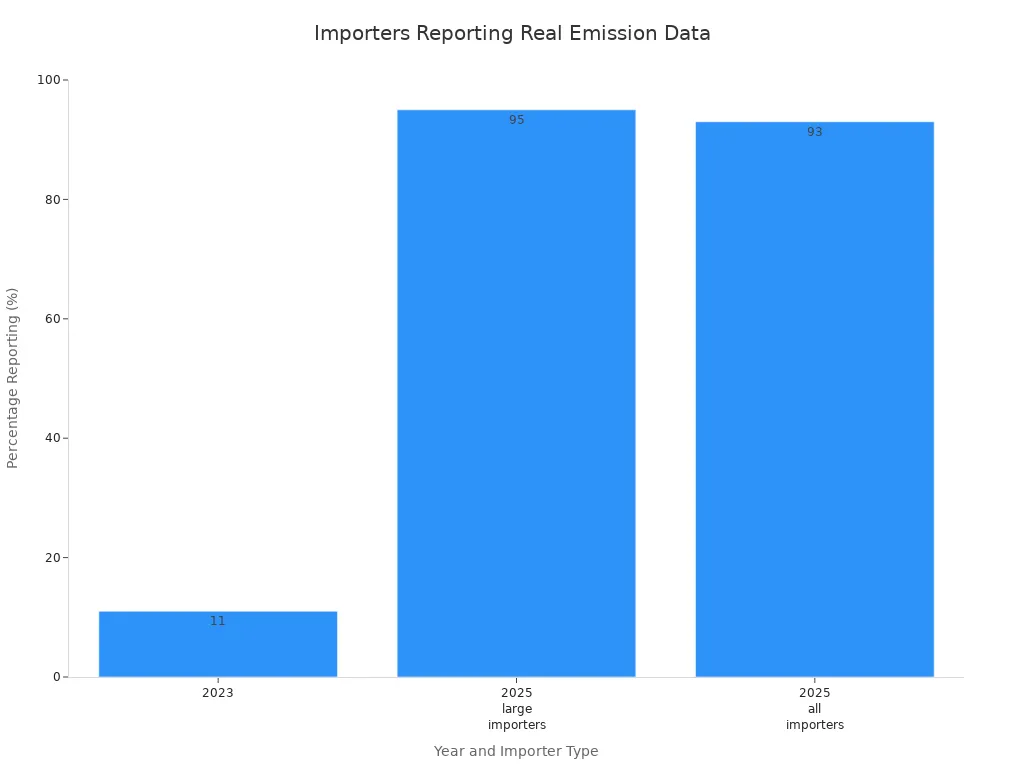
You need to change fast because of new cbam rules. Many steel exporters now check and share real emission data. Compliance rates are rising quickly. In 2023, only 11% of importers shared real emission data. By 2025, 95% of large importers and 93% of all importers will share real data. This means exporters are working hard to cut carbon.
Year | Percentage of Importers Reporting Real Emission Data |
2023 | 11% |
2025 | 95% (large importers) |
2025 | 93% (including small-scale importers) |
Exporters spend money on cleaner technology. They switch to low-carbon ways to make steel. This helps meet eu rules and lowers cbam costs.
Partnerships
Working with other companies and groups helps you. Exporters team up to share good ideas and lower carbon emissions. You join industry groups and work with buyers to make supply chains clearer. These partnerships help you stay strong in the market and handle cbam changes.
Tip: Make good connections with buyers and suppliers. This helps you follow rules and makes your market position better.
Policy and Trade Negotiations
EU Engagement
The eu talks with big steel-exporting countries about cbam. They discuss protectionism, how hard the rules are, and what happens with the money. The eu and India focus on technical talks and working together to use cbam well.
Key Points of Engagement | Description |
Countries Involved | EU and India |
Main Focus | Carbon Border Adjustment Mechanism (CBAM) |
Concerns Addressed | Protectionism, implementation complexity, revenue use |
Future Cooperation | Technical dialogue and mutual interest in effective implementation |
Some think cbam is protectionist
It is hard to measure carbon footprints
People worry about how money is used
There is a need for clear and fair rules
Trade Talks
Trade talks about cbam and steel trade keep going. Countries react in different ways. Some use carbon pricing and change their policies. Others show little opposition or try to make deals. A few countries only show political opposition.
Country Type | Response Type | Examples of Actions Taken |
Trade Countries | Policy Adoption | Adoption of carbon pricing, policy reforms, and decarbonisation measures (e.g., China, India, South Korea) |
Justice Countries | Limited Political Opposition | General opposition against unilateral climate measures at UNFCCC without specific focus on CBAM (e.g., Bhutan, Jamaica) |
Power Countries | Bargaining Attempts | India’s attempts to negotiate and South Korea’s recognition of domestic policies (carbon pricing) |
Non-Responsive | No Significant Reaction | Countries like Bahrain, Saudi Arabia, and UAE showed no reaction beyond political opposition |
You see important topics in trade talks:
Key Topics | Implications |
Trade disputes | There may be conflicts because of cbam, especially with growing economies. |
Economic pressures on developing countries | Developing countries may have trouble following cbam rules, causing economic gaps. |
International cooperation on carbon pricing | Countries need to work together to make fair carbon pricing and avoid trade problems. |
Domestic carbon policies | Countries are making their own carbon rules because of cbam, showing progress. |
Investment in decarbonization technologies | Businesses are spending more on technology to cut carbon emissions. |
You need to pay attention to these talks. They decide how steel trade will change and how cbam affects your business.
You can see cbam is making the steel trade different. You have to follow new rules for reporting. You need to keep track of emissions. You also must change how you get your materials. Companies that use low-carbon technology do better. The table below shows the main changes:
Key Change | Impact on You |
Emissions Reporting | You need to track more data |
Supply Chain Shifts | You must find new sources |
Cost Pressures | Exporting will cost more |
Technology Investment | You need cleaner methods |
Check for new policy updates often.
Put money into green technology to stay ahead.
The steel trade will keep changing as countries want cleaner ways to make steel.
FAQ
What is the main goal of CBAM for steel trade?
CBAM wants to make steel trade fair. You pay for the carbon in your steel. This helps lower global emissions and stops unfair price gaps between EU and non-EU steel.
How do you report carbon emissions for CBAM?
You must collect data on your steel’s carbon emissions. You send this data to EU importers. You update your supply chain documents to show your emissions clearly.
Will CBAM increase your steel export costs?
Yes, you pay a carbon fee for each tonne of steel you export to the EU. This fee can change each year. You need to plan for higher costs.
What happens if you do not follow CBAM rules?
If you do not follow CBAM rules, you may face penalties, border delays, or lose access to the EU market. You must report emissions and buy certificates.
Can you lower your CBAM costs?
You can lower costs by using cleaner production methods. Switch to electric arc furnaces or use more recycled steel. Invest in green technology to cut emissions.
Which countries will face the highest CBAM charges?
Country | CBAM Charges (€/tonne) |
China | 144 |
India | 234–703 |
Indonesia | 234–703 |
Countries with high emissions pay more. Cleaner producers pay less.
How does CBAM affect your supply chain?
You may need to find new suppliers with lower emissions. You might change your production location. You must track carbon data at every step.