Global steel demand will stay steady in 2025 at 1.75 billion tonnes of steel. The market thinks demand for
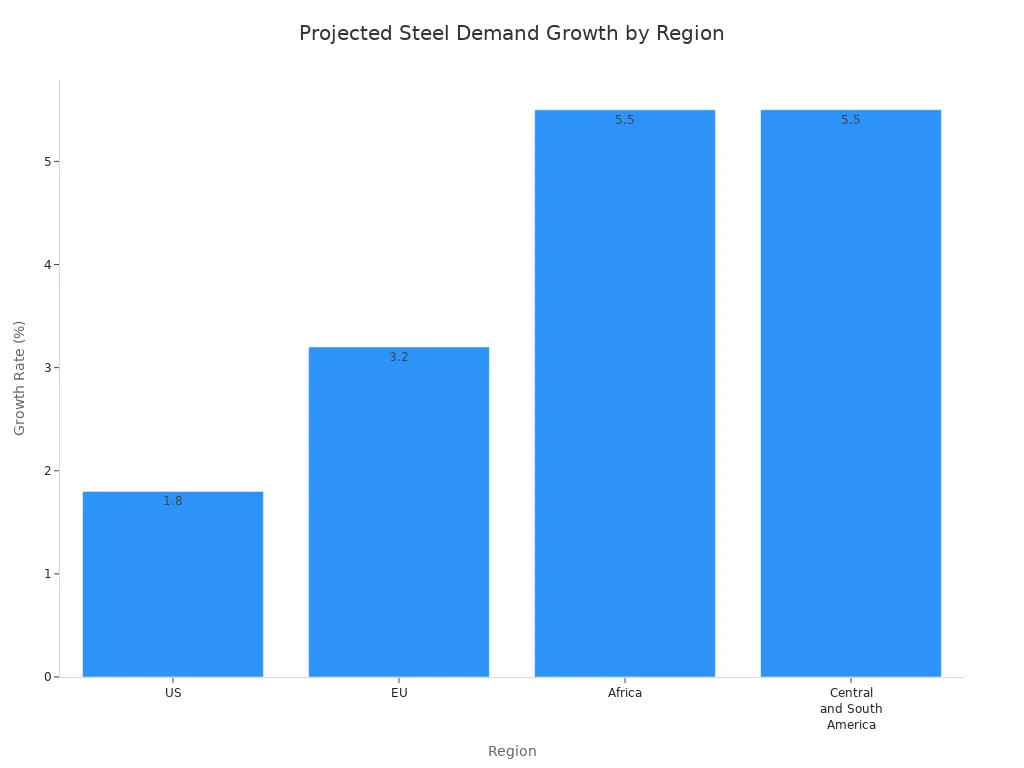
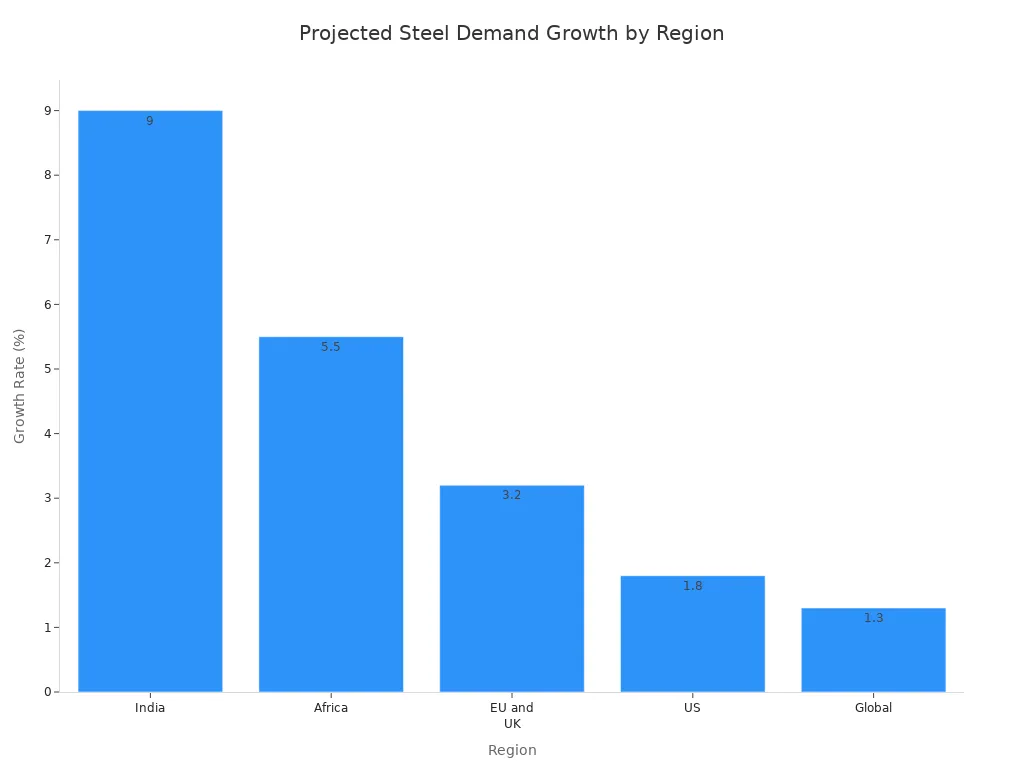
steel products will go up by 1.3% to 1,773 million tonnes in 2026. Many places help make this change happen. Africa and Central and South America grow by 5.5% each year. India needs steel for building roads and homes in cities. The table below shows the expected numbers:
Year | Global Steel Demand (billion tonnes) | Change (%) |
2025 | 1.75 | N/A |
2026 | 1.773 | 1.3 |
Different regions and market problems affect global steel demand. Helpful economic factors, like government spending and increased construction, are important for the growth of steel products.
Key Takeaways
Global steel demand will stay steady at 1.75 billion tonnes in 2025. It will go up a little to 1.773 billion tonnes in 2026. India will be the main country where steel demand grows. Steel demand in India will go up by 9% in 2025 and again in 2026. This is because of many new infrastructure projects. Developing countries will also see more steel demand. This is true in Africa and Central and South America. Their steel demand will grow by about 5.5% each year. Rich countries might see steel demand get better by 2026. Their steel demand could go up by 1.5% as they spend more on infrastructure. Too much steel and trade protectionism are big problems for the steel market. These problems change prices and how much steel is made in different places.
Global Steel Demand Trends
2025 Stabilization Overview
The global steel market will stay steady in 2025. The World Steel Association says steel demand will be about 1.75 billion tonnes. This is almost the same as last year. Many things help keep the market stable:
Big countries spend money on public projects. This helps steel demand.
The world economy stays strong. This keeps demand steady.
Experts like Alfonso Hidalgo de Calcerrada from UNESID are hopeful. They think the market will not drop more in 2025.
Rich countries will see a small drop in steel demand. It will go down by about 0.5% from last year. Poorer countries will grow faster. They will see steel demand go up by 3.4% in 2025. These changes show how different places affect the steel market.
2026 Growth Forecast
In 2026, the steel market will grow. The forecast says demand will rise by 1.3%. It will reach 1,773 million tonnes. Some important things push this growth:
China’s steel demand will not drop as fast. India, Vietnam, Egypt, and Saudi Arabia will grow quickly. India will see steel demand go up by about 9% in both 2025 and 2026. The United States will get more steel demand from new roads and homes. Steel demand in the U.S. could rise by 1.8%. Europe will also do better. It will see a 3.2% increase in 2026. More spending on roads and defense will help.
The table below shows how regions will do:
Region | Demand Forecasts | Key Challenges |
China | Declining | Overcapacity, declining domestic consumption |
India | Strong growth | N/A |
Europe | Low demand | Tariffs, economic pressure |
U.S. | Benefiting | Protectionist measures, economic slowdowns |
These trends show the steel market depends on growth and problems in different places. Growth in poorer countries will help balance slow demand in richer ones.
Historical Comparison
Looking at past years helps us understand now. The steel market will stay around 1,750 million tonnes in 2025. This comes after slow growth. In 2026, the market will bounce back a little, with a 1.3% rise. Poorer countries, especially outside China, will lead this growth. India and Vietnam will help demand go higher. Africa has seen steel demand grow by 5.5% each year since 2023. Central and South America will also grow by 5.5% in 2025. Argentina and Brazil will lead this growth.
Rich countries have had four years of falling steel demand. In 2026, they will recover. They will see a 1.5% increase. More spending on roads in the European Union and the United States will help.
Note: The steel market shows both steady demand and new growth. Differences between regions and spending on roads are important for these trends.
Regional Steel Market Analysis
China Demand Outlook
China is still very important in the steel market. In 2025 and 2026, steel demand will go up a little. Steel exports from China should rise by 3-5% each year. Some things help this happen. Raw material prices are not changing much now. Green steel technology is getting better. Trade problems with other countries also matter. China spends a lot on new roads and buildings. It wants to make steel without adding more carbon. China hopes to make 4% more value-added steel each year. This focus on better steel may change world steel prices and supply.
India Growth Drivers
India is growing fast in steel demand. By 2025, India’s steel use will go up by 8-9%. Most steel is used for big projects like roads and bridges. Building homes uses about 25% to 30% of the steel. Factories use 15-20% of the steel. Experts think India will use 9% more steel each year in 2025 and 2026. India wants to make 300 million tonnes of steel by 2030. Right now, it can make about 200 million tonnes. So, India needs to build more steel plants.
Aspect | Details |
Capital Expenditure Increase | Spending will go up by 22.2%, reaching ₹12.2 hundred thousand ten million for steel |
Infrastructure Projects | Lots of money goes to roads, railways, ports, and moving goods |
Logistics Improvements | Better ways to move goods will lower costs |
Support for MSMEs | Helping small factories in cities makes more people buy steel |
Overall Demand Outlook | Cities and small factories will keep steel demand strong |
Developed Markets Recovery
Rich countries have different results. Steel demand will drop by 0.5% in 2025. This is the fourth year in a row it has dropped. But things may get better soon. The European Union and United Kingdom could see steel demand go up by 3.2% in 2026. The United States may see a 1.8% rise in steel use. In total, rich countries could see a 1.5% recovery in 2026 after hard times.
Developing Markets Expansion
Poorer countries, except China, are growing fast in steel use. In 2025, these places will use 3.4% more steel. In 2026, the growth will be 4.7%. India and Southeast Asia are leading this growth. India will use 7% more steel in 2025. Southeast Asia will use 4% more. Big building projects and more people living in cities make this happen.
Year | Projected Steel Demand Growth Rate |
2025 | 3.4% |
2026 | 4.7% |
Developing countries are very important for world steel demand. Their spending on new buildings and factories helps balance slow growth in rich countries.
Global Steel Market Dynamics
Oversupply Challenges
The global steel market has too much steel. Many countries are making more steel than needed. China is making the most steel. Because China makes so much, other countries get extra steel. This makes prices go down and profits smaller. Some companies in Southeast Asia went out of business because of this. Here are the main problems with oversupply:
Chinese steel exports are filling up markets and lowering profits.
Too much steel means prices drop and credit risks go up.
Overcapacity caused a 2.8% fall in production from January to August 2025.
Stricter sustainability rules are changing how much steel is made.
Countries use tariffs and restrictions, but new economies keep making more steel.
The table shows how capacity affects the market:
Evidence Source | Key Data |
OECD Steel Committee | Global steel overcapacity could be more than 680 million tons by 2025. |
| Production capacity may reach 2.656 billion tons by 2028. |
Steel Price Trends | Indian hot-rolled coil prices dropped by 18.9% in 2025 because of too much steel. |
Protectionism Impact
Many governments are trying to protect their own steel industries. The US raised tariffs on steel imports from 25% to 50%. These rules help keep steel jobs safe. India and other countries get more steel from China and Japan. This makes prices go down and hurts local steelmakers. The US uses a "melt and pour" rule to control steel coming in. These rules can make things cost more for businesses and change how much steel is used.
Measure | Details |
Tariff-rate quotas | Cut by 47% |
Tariffs | Went up from 25% to 50% |
New requirement | 'Melt and pour' rule for steel imports |
Trade Flow Shifts
Steel trade is changing quickly. The European Union uses the Carbon Border Adjustment Mechanism. This rule makes it cost more to send steel from Southeast Asia and Latin America. Exporters must use low-carbon ways to stay competitive. The US has higher prices at home, so it buys more steel that fits its rules. Mexico’s "Plan Mexico" makes people want more construction steel and buy from nearby suppliers. Southeast Asia buys more high-quality steel for building. Tariffs in Mexico push trade to South America, making Brazil’s market stronger. New roads in northern Canada and Russia change trade routes and how much steel is needed.
Economic and Policy Support
Helpful economic and policy actions support the steel market. India grows its capacity by spending on roads and reforms. Africa grows its capacity with economic changes. The EU and UK spend more on defense and roads, which helps use more steel. The US spends more on roads and homes, helping its own steel industry. Around the world, better financing and a strong economy help steel demand go up in 2026.
Note: How much steel is made, government rules, and trade will decide the future of the steel market.
Steel Production and Pricing Outlook
Raw Material Trends
Steel needs a steady flow of raw materials. Iron ore and scrap metal are very important for prices. If iron ore is hard to find, steel prices go up. In 2025 and 2026, iron ore prices may rise by 5-8% in January. This happens because steel mills buy more before the Chinese New Year. Scrap metal prices have dropped lately since fewer people want finished steel. Lower scrap prices help steel mills now, but less scrap may be collected later. If there is not enough scrap, making steel could cost more. Class 1 Nickel is also getting harder to find. This will likely make the Alloy Surcharge for stainless steel fasteners go up in early 2026. These changes show that raw materials are very important for steel prices and the world economy.
Price Forecasts for 2025-2026
Steel prices will stay higher than before 2020, but they will go up and down. In October 2025, structural steel costs $2,477.25 per ton. By January 2026, prices may fall to $2,343.93 per ton. This is a 5.38% drop from late 2025. Prices are also 4.7% lower than last year. Even with this drop, prices will not go back to old lows. Strong demand from building and new rules will keep prices high. Buyers should know prices will stay in a certain range. Waiting for big price drops may not work, since dips could be short. Buying steel at different times can help control costs. Steel prices will show the need for strong materials and more money spent on factories.
Implications for Stakeholders
Steel prices matter to many people. Producers may earn more money and get more investments, especially with tariffs. Builders and car makers will pay more for steel products. This could make goods cost more and cause inflation. High tariffs help local steel makers grow, but there are risks if demand does not rise. Companies with good long-term deals will do better. Building more data centers and energy projects gives new chances to grow. Steel makers must keep up with how much people need. The world economy and market rules may stop prices from rising too much, but steady prices help with planning and investment.
Tip: Plan for higher steel costs and do not wait for big price drops. Buy steel at different times to lower risk and use steady prices to your advantage.
Global steel demand will stay the same in 2025. It will be 1.75 billion tonnes. In 2026, it will go up by 1.3%. India and other growing places will help this happen. Changes in the market, government rules, and new buildings are important. Leaders in the industry can learn from these facts:
Key Driver | Insight |
Infrastructure Development | Cities in new markets need more steel for roads and buildings. |
Automotive Industry Evolution | Electric cars and safety rules mean more advanced steel is needed. |
Manufacturing and Industrial Growth | More factories and moving jobs back home use more steel. |
Renewable Energy Transition | Wind and solar projects need a lot of steel. |
Government Policies | Country plans and clean energy rules make steel demand higher. |
FAQ
What factors influence global steel demand?
Many things affect steel demand. Building roads and bridges is important. Governments spend money to help the economy grow. New technology and changes in factories matter too. These things decide how much steel is needed each year.
How does steel demand in europe compare to other regions?
Steel demand in Europe grows slower than in developing places. Europe needs new roads and defense spending to recover. India and Brazil use more steel and grow faster.
Why do steel prices change so often?
Steel prices change because of supply and demand. Raw material costs also matter. Trade rules and tariffs can make prices go up or down. Buying at certain times and world events cause quick price changes.
Which industries use the most steel?
Construction uses a lot of steel. Car makers and factories need steel too. Wind and solar projects use steel for their equipment. Data centers need steel for their buildings.
How do government policies affect steel markets?
Governments set rules to protect local steel makers. Tariffs and quotas change how steel moves between countries. These rules can make prices go up or down. Spending on roads helps steel demand grow.