You see
galvanized coil prices shift daily because of raw material costs, supply and demand, and global trends. Prices usually range from $500 to $1,200 per ton. These coils help protect buildings and appliances from rust. You rely on
galvanized coil for strong, corrosion-resistant structures.
The global market size reached $20 billion in 2024 and is projected to hit $71.86 billion by 2030, growing about 5% each year.
Sino Steel helps you meet this demand with reliable products.
Key Takeaways
Galvanized coil prices change because of raw material costs. Prices also change because of supply and demand. Trade policies can make prices go up or down. You should stay updated to buy at the best time.
Knowing what affects prices helps you pick materials. Steel grade and coating thickness are important. These things help you choose the right material for your project.
Prices are different in each region. North America has high demand for coils. Asia-Pacific has lower prices because there is more competition.
To save money, use more than one supplier. You can also make long-term deals. Watch market trends to manage costs well.
If galvanized coil prices get too high, look at other choices. Galvalume steel or aluminum are good options. Each choice has special benefits for your project.
Galvanized Coil Price Drivers
Knowing what affects the price of galvanized coil helps you make smart choices. Many things change the cost, like raw materials and trade rules. You should think about steel grade, coating thickness, coil size, and the market when looking at prices. Galvanized coil usually costs $500 to $1,200 per ton. These things can make the price go up or down.
Raw Material Costs
Raw material costs are very important for galvanized coil prices. The price of steel and zinc changes a lot. If steel or zinc gets more expensive, galvanized coil costs more. Zinc is a shield for steel, and its price depends on world supply and demand. Steel prices change with iron ore, coal, and energy costs. If a big zinc maker has problems, coil prices can rise fast.
The price of galvanized steel coils depends on steel and zinc costs.
When these prices change, it affects how much it costs to make coils.
Zinc protects steel coils and its price changes with the world market.
Steel prices depend on what it costs to get raw materials and how much is made worldwide.
Supply & Demand
Supply and demand change how much galvanized coil costs. If fewer people want coils for cars or buildings, prices drop. North America has a lot of coils in stock, so prices are lower. Suppliers from Turkey and Vietnam make prices go down because they compete. In Europe, imported hot-rolled coils with tax breaks lower local prices. When car and building companies buy less, prices fall.
North America has lots of coils, so prices go down.
Turkish and Vietnamese suppliers make prices lower.
Less buying from car and building companies means prices drop.
Europe gets cheaper coils from other countries with tax breaks.
Central Europe has weak demand and mills try to keep profits.
Regional Trends
Different places affect the galvanized coil market in their own ways. North America needs more coils for cars and buildings. Asia-Pacific grows fast as China and India build more factories and roads. The Middle East and Africa want to build in ways that last longer, so they need more corrosion-resistant materials.
North America needs more coils for cars and buildings.
Asia-Pacific grows fast because of new cities and roads.
The Middle East and Africa want to build things that last, so they use more galvanized coil.
Production Costs
Production costs include workers, machines, and energy. Making more coils at once can lower the cost for each one. Moving coils from far away costs more money. People often buy locally to save on these costs.
Cost Component | Description |
Raw Material Cost | Changes with steel and zinc prices; suppliers keep stock to control costs. |
Production Costs | Includes machines, energy, and workers; making more lowers the cost for each coil. |
Transportation Costs | Changes by area; high costs can make people buy closer to home. |
Trade Policies
Trade rules and tariffs can change galvanized coil prices fast. The U.S. put a 25% tariff on steel from other countries, so it costs more for buyers in the U.S. Tariff fights mess up supply chains and make you look for new sellers. The EU put extra taxes on hot-rolled coils from some countries, which changes prices there. New rules and limits can make it harder to get coils and raise prices.
Trade rules and tariffs, like the 25% U.S. tariff, make coils cost more.
Tariff fights mess up supply chains and make companies find new sellers.
Places with strong local industries can save money.
The EU put extra taxes on some imports and is checking others.
Evidence Type | Description |
Increased Trade Protection | The EU put extra taxes on hot-rolled coil and sheets from some countries. |
Investigations Initiated | The EU is checking cold-rolled coils and sheets from many countries. |
Trade Restrictions | Limits on Iran’s supply chains can change how much steel is available. |
Tip: You can lower price risks by watching trade rule changes and picking suppliers with steady supply chains.
How Steel Grade, Coating Thickness, and Coil Dimensions Affect Price
Technical things matter too. Higher steel grades, thicker coatings, and special coil sizes cost more. A thicker zinc coating or special paint makes the price go up. Thinner sheets can cost more because they are harder to make.
Coating Type | Thickness Increase | Price Increase |
Zinc | +10g | +$10 |
Paint (pe) | +1mic | +$5 |
Paint (SMP) | +1mic | +$10 |
Coil size, like thickness and width, changes the price. Thinner sheets usually cost more.
Market conditions, like supply and demand for raw materials, are important.
Prices are different in each place because of shipping and local supply and demand.
The price of galvanized coil depends on material, zinc coating, specs, size, where it comes from, brand, and market supply and demand.
Note: When you pick galvanized coil for your project, think about all these things to get the best deal.
If you want a partner who knows these market drivers, Shandong Sino Steel Co., Ltd. can help. They have a full process and good galvanized coil products. Their experience in making, processing, and selling worldwide helps you save money and get coils, even when the market changes.
Price Trends & Forecasts
North America
Galvanized coil prices in North America are going up in early 2025. The Hot Dipped Galvanised Coil market closed at $1,487 per metric ton for 1 mm coils in Illinois. This happened because construction and manufacturing are getting stronger. Raw material costs and more demand made prices rise by 2.5% in February and March. Big companies like Nucor and Cleveland-Cliffs changed their prices to follow these trends. Labor costs and problems in the supply chain also affect prices.
Europe
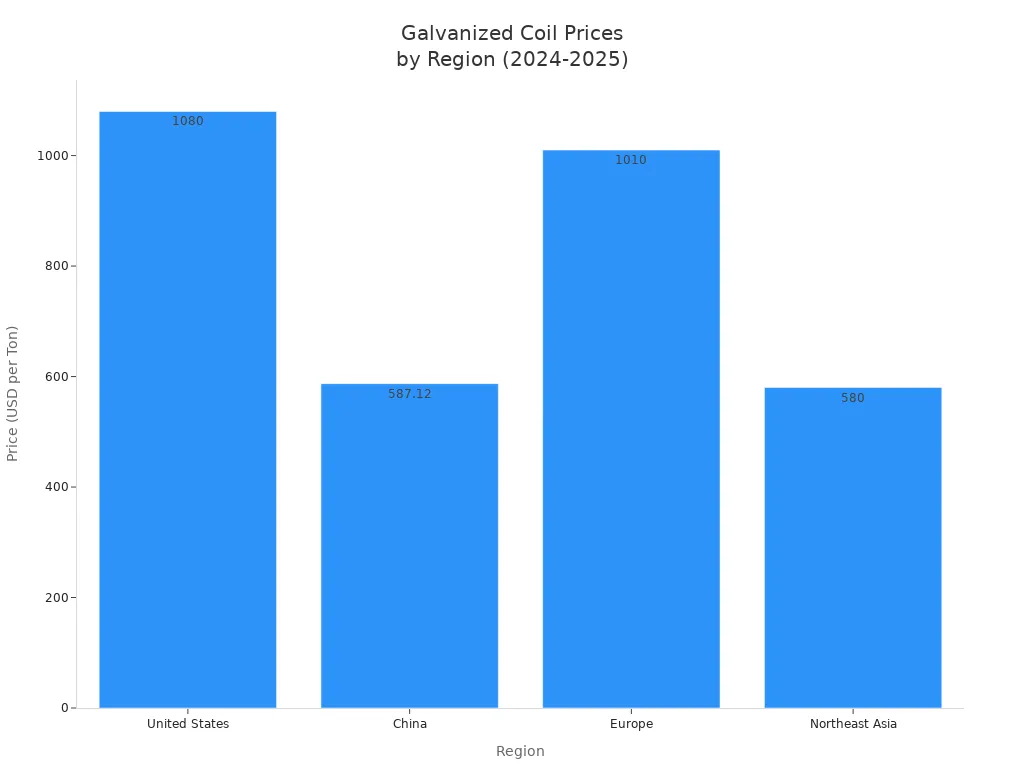
Prices in Europe are higher than in other places. In January 2025, galvanized coil prices were $1,010 per ton. Environmental rules and local demand keep prices high. Europe faces competition from imports, but local laws help protect their own producers.
Region | Price (USD per Ton) | Date |
United States | $1,080 | July 2024 |
China | $587.12 | July 2024 |
Europe | $1,010 | Jan 2025 |
Northeast Asia | $580 | Jan 2025 |
You can see that changes in raw material costs, local demand, and global production—especially from China—affect the European market.
Asia-Pacific
Asia-Pacific has the lowest galvanized coil prices. In January 2025, Northeast Asia prices were $580 per ton. Strong demand from building, cars, and infrastructure helps the market grow. New technology and using better materials also help. China and India lead with more factories and good supply chains.
Global Outlook
The global galvanized coil market reached $24.15 billion and keeps growing. Experts think the market for galvanized and coated iron and steel sheets will go from $170.3 billion in 2025 to $267.0 billion by 2035, growing 4.6% each year. Prices may drop for a short time in early 2025, but should go up again by 2027 as more people need coils for building and cars.
Region | Price Influence |
Asia | Lowest prices because of Chinese competition |
Europe | Higher prices because of environmental rules |
North America | Higher prices because of trade protections |
Note: You can lower price risks by learning about trends in each region and picking suppliers you trust.
When you plan your projects, think about working with a trusted partner. Shandong Sino Steel Co., Ltd. gives you high-quality steel products all over the world. Their strong supply chain and new production methods help you get the best materials, even when the market changes.
Galvanized Coil in Construction
Roofing & Siding
You see galvanized coil used in many parts of a building. It protects roofs and walls from rain, wind, and rust. Builders choose it for its long life and low upkeep. You can find it in:
Roof panels that resist rust and last for years.
Wall cladding that adds strength and looks good.
Gutters and downspouts that handle heavy rain and do not corrode.
These uses keep your building safe and looking new. When the price of galvanized coil changes, the cost of roofing and siding materials changes too. Higher coil prices mean you pay more for both materials and labor. Market shifts, supply chain problems, and world events can all change what you pay for these products.
Structural Applications
You rely on galvanized coil for strong building frames and supports. It works well in steel frames, beams, and reinforcement bars. Its strength and resistance to weather make it a top choice for builders. You also see it in fencing and barriers around job sites. These products stand up to impact and water, so you get safety and durability.
Cost Impact for Builders
Price changes in galvanized coil affect your project budget. You need to plan for these shifts to avoid going over budget. Here is how you can manage costs:
Factor | How It Helps You Save Money |
Cost Management | You make better buying choices when you know what drives prices. |
Negotiating Power | You get better deals by understanding market trends and talking with suppliers. |
Project Planning | You estimate costs more accurately and avoid surprises. |
Economic Efficiency | You buy at the right time and cut expenses by watching the market. |
Smart builders use strategies to manage price swings. You can adjust your bids, set expiration dates, or buy materials early. Some builders add clauses to contracts that let prices change if the market shifts. Good communication with suppliers helps you stay ahead of changes.
Tip: When you work with a trusted supplier, you get better prices and steady supply. Shandong Sino Steel Co., Ltd. offers high-quality steel products and helps you manage costs, even when the market changes.
Appliance & Other Industry Uses
Household Appliances
Galvanized coil is used in many home appliances. You see it in refrigerators, washing machines, and air conditioners. This material gives a smooth look and protects from rust. Your appliances last longer and look nice in your house. The zinc coating keeps water out. This helps your appliances work well, even in wet kitchens or laundry rooms.
Galvanized steel coils are found in fridges, washers, and air conditioners.
The smooth finish makes appliances look better.
Rust resistance makes them good for kitchenware and tools.
When you pick appliances, you want them to last and look good. Galvanized coil helps makers give you both.
Automotive & Agriculture
Galvanized coil is used in cars, trucks, and farm machines. Car makers use it for body panels, frames, and parts under the car. This keeps cars from rusting, so they last longer. In farming, galvanized coil is used for storage buildings, silos, and fences. Farmers like it because it stands up to rain and sun.
In cars, galvanized steel coil is used for body parts and frames.
It helps cars last longer by stopping rust.
In farming, it is used for storage, silos, and fences.
The material works well outside, even when it is wet.
Manufacturing Costs
When galvanized coil prices change, it changes how much it costs to make things. If raw materials cost more, it costs more to make appliances, cars, and machines. Companies may charge you more for these products. If prices go down, you might pay less in stores.
Factor Affecting Cost | Impact on Manufacturing |
Raw material prices | Directly change what it costs to make |
Zinc price changes | Make coil and product prices go up or down |
Coating thickness | Thicker coatings cost more |
New technology | Makes things better but can cost more |
Note: When more people want these products, prices can go up. Companies change prices fast when the market changes.
If you want steady supply and fair prices, work with a trusted partner. Shandong Sino Steel Co., Ltd. has many steel products, including galvanized coil. Their strong supply chain helps you control costs and stay ahead.
Navigating Price Volatility
Risk Management
Prices for galvanized coil change a lot every year. You need to pay attention and use smart ways to handle these changes.
Watch the market closely. Check raw material prices and global trade rules. This helps you see price changes early.
Use more than one supplier. Do not depend on just one. This keeps your supply safe if the market changes.
Be flexible when buying. Use both long-term deals and spot buys. This helps you get good prices and be ready for surprises.
You can also try these helpful methods:
Just-in-Time (JIT) inventory means you order steel only when you need it. This saves money on storage but needs a strong supply chain.
Buy in bulk when prices are low. This saves money but you need more cash.
Long-term deals help you keep prices steady and get coils when you need them. Many deals have rules for market changes.
Tip: You lower your risk by using more than one method. Stay up-to-date and act fast.
Supplier Strategies
Working with suppliers can help you avoid big price jumps. Long-term deals keep prices steady and make sure you get enough galvanized coil. When you set prices for months or years, you control your costs. This helps you do better than others who face sudden price hikes. Good suppliers help you plan and avoid delays that cost money.
Material Alternatives
Sometimes, you need to pick other materials instead of galvanized coil. Other choices might fit your project and budget. Here is a simple comparison:
Material | Cost Range (per square foot) | Notes |
Galvalume Steel Coils | $0.75 - $1.50 | Cheaper, strong, and good for building projects. |
Aluminum Sheets | 20% - 35% more expensive | Light, great at stopping rust, best for transport. |
You can pick galvalume steel for a lower price. Aluminum is better if you need more rust protection. Each choice has its own good points.
Note: Looking at other materials helps you finish projects even when galvanized coil prices go up.
Shandong Sino Steel Co., Ltd. helps you through every market change. You get many steel products, like galvanized and galvalume coils, prepainted panels, and special sheets. Their strong supply chain and focus on quality help you save money and keep your projects moving.
Galvanized coil prices change because of raw material costs, supply and demand, and world trade. These changes can affect your building projects and the appliances you use at home. To keep up with price changes, watch these important numbers:
Metric | Value |
Current Price Spread | $173/st (12-month avg) |
Current Percentage Premium | 16% (two-year low) |
Previous Year Premium Range | 27-34% |
Always pay attention to what is happening in the market. You can do better by working with companies like Shandong Sino Steel Co., Ltd. They are experts in steel coils and prepainted coils. Their strong factories, worldwide business, and focus on good quality help you do well, no matter how the market changes.
FAQ
What is galvanized coil used for in construction?
You use galvanized coil for roofing, siding, beams, and reinforcement bars. It protects buildings from rust and weather. Builders choose it for its strength and long life.
Why do galvanized coil prices change so often?
You see prices change because of raw material costs, supply and demand, and trade policies. When steel or zinc prices move, coil prices follow. Global events and local demand also play a big role.
How can you manage the risk of price swings?
You can manage risk by working with several suppliers, signing long-term contracts, and watching market trends. Buying in bulk or using just-in-time inventory also helps you control costs.
Are there alternatives to galvanized coil?
Yes. You can use galvalume steel or aluminum sheets. Galvalume costs less and works well for buildings. Aluminum resists rust better but costs more. Each option fits different needs.
Where can you find a reliable galvanized coil supplier?
You can trust Shandong Sino Steel Co., Ltd. for high-quality steel products. The company offers a full range of coils and sheets, strong supply chains, and expert service. You get reliable delivery and support for your projects worldwide.